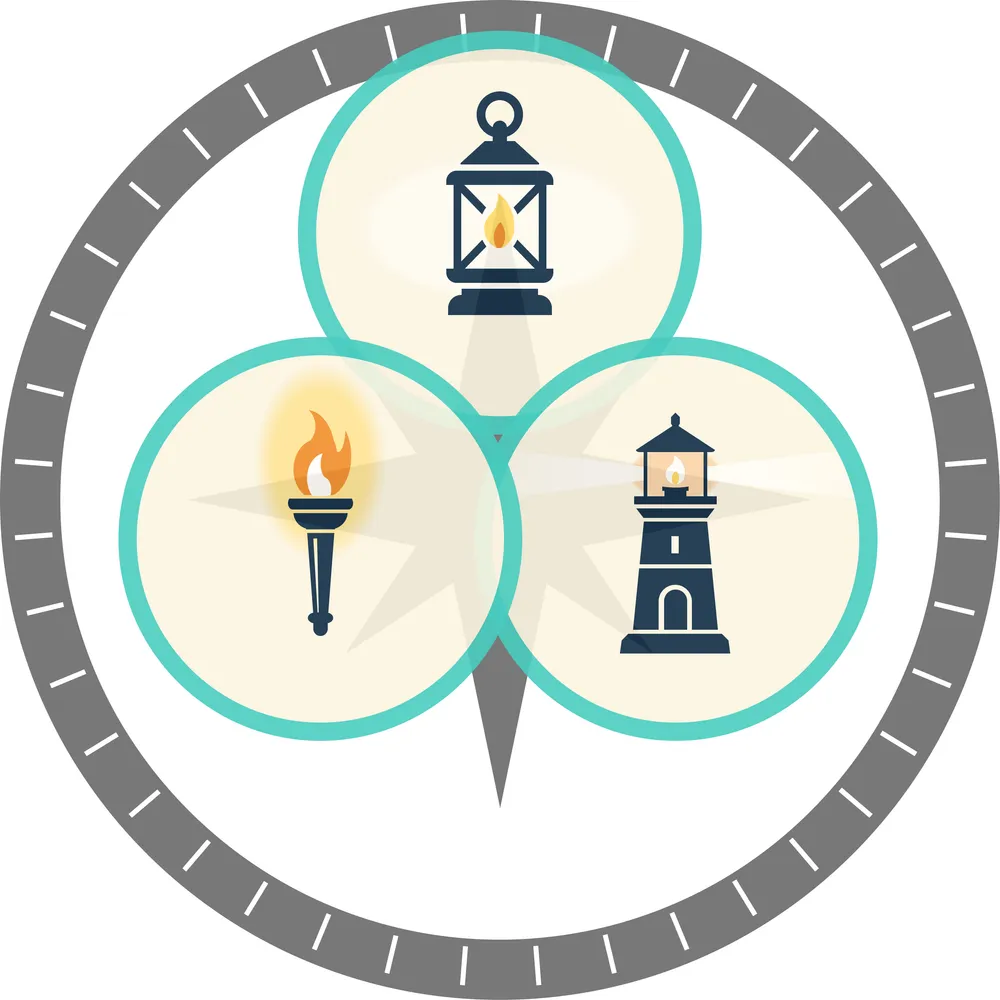
An effective analyst knows how to identify and shift between mindset as needed to accomplish their task. The Curious Mind, The Prepared Mind, and the Judicious Mind all compliment eachother and aide throughout the analytical process.
The Three Minds of Effective Analysis
Analysis is not exclusively about intelligence. Often it’s about asking the right questions, organizing information, or making a decision under uncertainty. Intelligent people aren’t immune from mistakes, many of us have seen, or made, these errors:
- Engaging in an endless line of questioning, without progressing towards a goal
- Constantly evaluating without resolution or “analysis paralysis”
- Making an unjustified judgement before sufficient information exists
To help address these common challenges Pelorus Academy teaches the Three Minds of Effective Analysis:
- The Curious Mind - Generates ideas, exploration, and possible ways to understand
- The Prepared Mind - Provides rigor, evaluates, plans
- The Judicious Mind - Decides, acts, and prioritizes effort
Each mind represents a mode of thinking - not a sequence of steps to be checked-off. All Three Minds are present at all times - just in varying degrees. They have their own individual strengths and weaknesses that can impact the analytical process.
Three Minds on Watch:
At sea all over the world, sailors take turns steering their vessels, standing lookout, and completing other tasks around the ship. The execution of these duties and the continuous shifting of responsibilities is called “standing watch” or simply being “on watch.” It literally means to take a turn watching over the ship and its safe navigation - their time to be at the helm and steer for the duration of that watch. While on shift, a sailor is never truly alone, help is always nearby on the bridge, or just a phone call away.
It is instructive to think of the Three Minds as characters exchanging time on watch. At any time, only one is at the helm, while the other two stand ready to assist as needed. All the minds have skills better suited to certain situations and so they take turns maneuvering the ship when their skills are needed.
Note, they don’t work sequentially - some situations call for curiosity to move forward, others need structure to organize things, while still others need a jolt to get out of hyperfocus or distraction. Each mind is called upon when needed, in any order. It is likely that we’ll begin in the Curious Mind since most analysis begins with a question. Similarly, we’ll probably end in the Judicious Mind, making the final decision that we are in fact, done. But the journey in between is fluid, with all minds collaborating to navigate.
The Curious Mind:
Humans are naturally curious, the entirety of scientific discovery is due to curious humans that sought to explain the world around them. A curious analyst asks a lot of questions, but this mindset isn’t just about inquiry. In fact, we ask questions in all of the mindsets, just for different purposes. Curiosity is about exploration and possibilities. It drives a deeper understanding, expands the range of possible understanding, and reveals answers we did not initially know how to pursue.
By adding just a little structure from the Prepared Mind, we can guide our curiosity in a general direction, hopefully getting to questions that help propel us forward in our endeavors. Some starting strategies for using structure in inquiry, are in our Inquiry Toolkit article.
At Pelorus, the Curious Mind is represented by a torch - useful for broad illumination and exploration of new ideas.
The Prepared Mind
While the Curious Mind wanders excitedly, learning and exploring, the Prepared Mind harnesses that energy and its results. Specifically, it provides two important functions:
- Learns patterns, creates structure, and evaluates - through actions like observation, categorization, and critical thinking (See our critical thinking toolkit)
- Identifies and mitigates Bias - All three types of bias (societal, statistical, and cognitive) can be guarded against with the Prepared Mind. (We also have a Bias toolkit)
We represent the Prepared Mind with a Lantern - it illuminates, but does so deliberately, often for a closer examination.
The Judicious Mind
This mindset is the decider. It exercises judgement over the other two:
- Have I been curious enough - Do we have enough data? Are other methods possible? How else might this be presented?
- Is this structure appropriate - Is enough information to begin? Has bias been addressed sufficiently? Is our thought process coherent?
At every stage of the analytical process, it’s the Judicious Mind that decides to move on. Every question posed by the Curious Mind and evaluated by the Prepared Mind then goes to the Judicious Mind for final adjudication - is this answer good enough, or not?
We represent the Judicious Mind with a lighthouse. It does not illuminate everything equally but its focused light orients us, providing direction and guidance.
The three Minds interacting
Three Minds were born out of Pelorus’ framework for structured analysis, UPDATE. While working to identify discrete steps and tasks - three things emerged that didn’t neatly fit in one given step: inquiry, critical thinking, and bias identification. They had to exist outside the framework because they complimented every stage. Over time, we realized that inquiry, critical thinking, and bias identification were tasks and tools, components to larger ideas which became the Three Minds.
In the same way that the Three Minds don’t fit into one step of UPDATE, no one mind is ever on watch alone. Each mind serves as a check on the others. Or stated another way, one mind is incomplete without the other two. If left to navigate by itself, each mind has a specific risk it can experience.
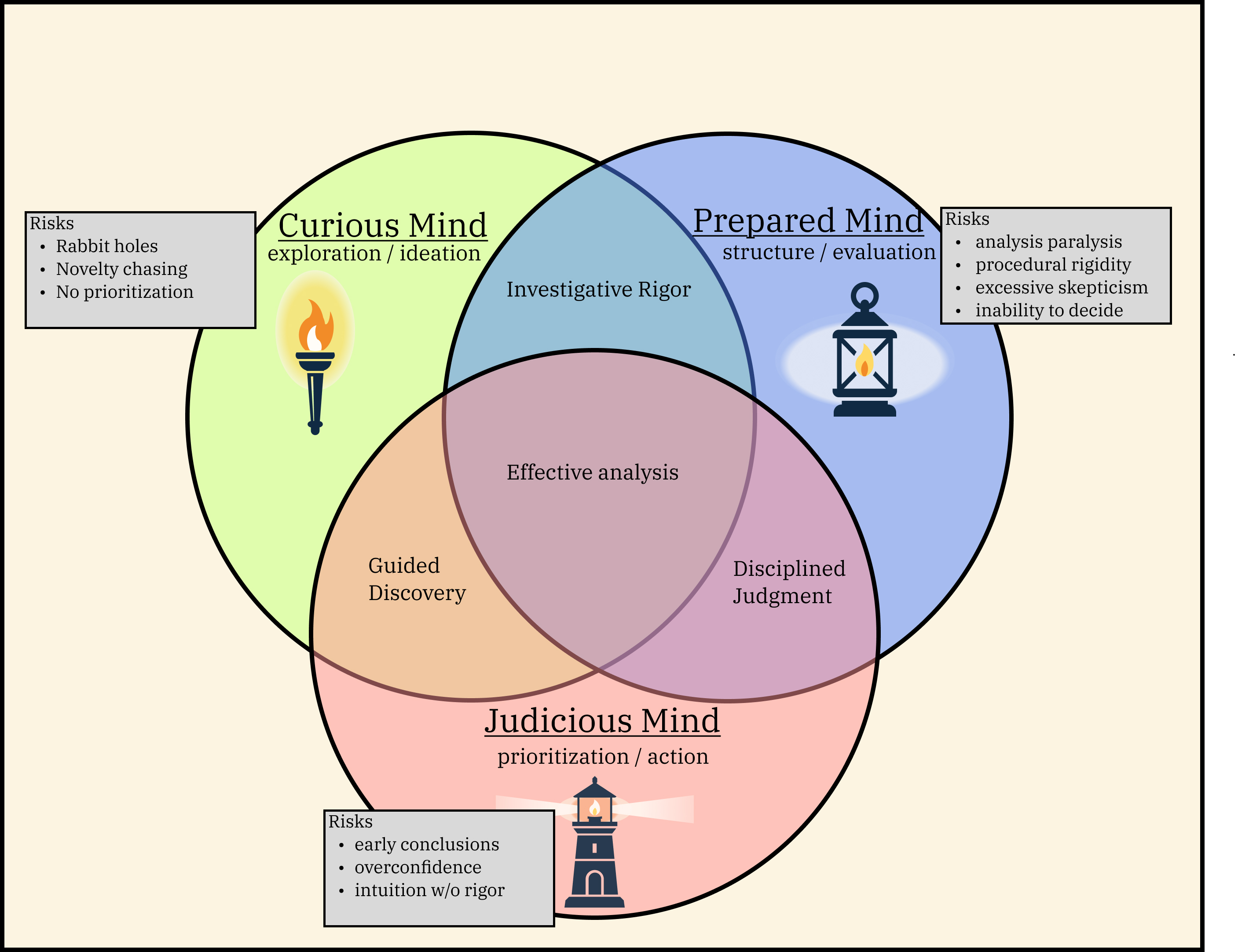
I believe there is utility in naming the characters - they have recognizable tendencies, strengths, and blind spots. These unique attributes allow you to identify which mindset you’re in or, if needed, consciously switch to a different mind. Additionally, knowing the minds also means you take steps to intentionally develop skills in that mindset - you can practice asking questions, building structure, evaluating critical thinking, or making decisions.
Three Minds, in closing
You don’t need a PhD in Psychology or decision science to understand or use the Three Minds, nor do you need decades of analytical expertise. Chances are, you’re using them already: when you notice something interesting and want to look into it more deeply, that’s the Curious Mind. When you get overwhelmed by information and feel the need to organize it to try and make sense of it all, that’s the Prepared Mind. And when you reach the point where you just have to make a decision and move on, that’s the Judicious Mind.
Now that you’ve been introduced to the three minds, it is our hope that you can more easily identify which mind is on watch, and more consciously switch between the minds as you identify the need. It can probably be tempting to identify only one mind you are most affiliated with - Resist that temptation! Ultimately, effective analysis is not about living permanently in one mindset. It is about learning which of the Three Mind should take the watch - and when.